01The restricted zone
Why Mérida sits inside a constitutional line.
Mexico's Constitution (Article 27) and the Foreign Investment Law reserve a strip of land for Mexican nationals: 50 kilometers from the coasts and 100 kilometers from the borders. That strip is the zona restringida, the restricted zone. Almost all of the Yucatán Peninsula that buyers actually want — Mérida, the Progreso coast, the pueblos along the corridor — sits inside it. Dzityá, north Mérida, is inside it.
This is not a ban on foreign buyers. It is a rule about how title is held. A Mexican citizen takes a direct deed, an escritura, in their own name. A foreigner buying a home in the restricted zone holds the beneficial rights through a fideicomiso, a bank trust. Residency does not change this: a foreigner with temporary or permanent residency still buys a family home in the zone through a trust. A Mexican company can hold property in the zone only for non-residential use; it is not a shortcut to a family house.
Outside the restricted zone — inland states, or parts of Mexico well away from the coast and the borders — a foreigner can take title directly, after a permit and a Calvo clause (an agreement not to invoke their government in a dispute over the property). In Mérida, that route is not available for a house. The trust is the path.
02What a fideicomiso is
A bank holds the paper. You hold the home.
A fideicomiso is a contract. A Mexican bank, authorized as a trustee (fiduciario), holds legal title to the property. You are the beneficiary (fideicomisario). The Ministry of Foreign Affairs (SRE) authorizes the trust for that specific property. The term is 50 years, and it can be renewed. You can name substitute beneficiaries, including your heirs.
In every way that matters for living in the house, the home is yours. You can live in it, remodel it, rent it out, sell it, and leave the beneficial rights to the people you name. The bank does not choose your tenants or your paint color. It holds title on paper, and it follows your lawful instructions.
If the house is already in a trust — many homes sold by other foreigners are — a buyer can often take over that trust by a cesión de derechos (an assignment of rights) instead of opening a new one. It is usually faster and cheaper, though the acquisition tax still applies. Ask before you offer. This is explained further in our buyer's guide.
03What you can and cannot do
Full use, with a few clear limits.
You can: occupy the home as your residence, rent it (including as a short-term rental, subject to municipal rules and tax), remodel it, put it up as security in some structures, sell your rights, and name heirs as substitute beneficiaries. You do not need to be a Mexican resident to buy; you do need to enter the country legally and identify yourself to the notary.
You cannot: hold the direct domain (dominio directo) in your own name inside the restricted zone, and you cannot use a Mexican company as a back door for a residential house. The Calvo clause, which is part of the permit, means you agree to be treated as a Mexican national for purposes of the property and not to call on your government in a dispute about it.
None of this is a substitute for a notary walking your specific file. Banks also have their own trust contracts and fee schedules. Read both before you sign.
04How it is set up
The usual path, from offer to keys.
The steps below are the common sequence in Yucatán. Your notary may adjust the order slightly. They are not a do-it-yourself checklist.
- Offer and promise of sale. Once you and the seller agree on a price, a promise-of-sale contract (contrato de promesa) is usually signed, and a deposit is agreed. In Mexico the deposit is often paid to the seller; confirm with your notary how it is held and what happens if either side walks away.
- The notary opens the file. The notary requests the no-lien certificate, the property tax status, the water and other municipal clearances, and, if a trust already exists, the bank's trust documents. This is also when you run the checks in the buyer's guide: that the land is not ejido, that the seller can actually sell, that the measurements match.
- The SRE permit and the bank. If a new trust is needed, the bank applies to the SRE for the permit on that property, with you as beneficiary. If you are taking over an existing trust, the bank processes the assignment instead. This step is often the one that sets the timetable — commonly a few weeks once the file is complete, not a few days.
- Closing at the notary. You sign, the seller signs, the bank signs as trustee, the acquisition tax (ISAI) and the notary's fees are paid, and the trust (or the assignment) is formalized. Funds typically move through the notary or according to the notary's written instructions — not in cash. The instrument is then recorded in the Public Registry.
A foreign buyer does not need a Mexican real estate license, and does not need to hire an agency, to complete this path. What you do need is a notary, and, if you want one, a lawyer of your own who is not also representing the seller.
05What it costs
Closing costs, plus the trust itself.
In Yucatán the buyer typically pays the closing costs: the municipal acquisition tax (ISAI), the notary's fees, appraisals, certificates and registry fees. Our buyer's guide works a full example and has a calculator on the home page. Those costs apply whether the buyer is Mexican or foreign.
On top of that, a new fideicomiso has its own bank charges: a setup fee and an annual administration fee. Both vary by bank and by the value of the home. We will not invent a number here. Ask two or three trustee banks for a written quote on the specific property, and ask whether a cesión of an existing trust would be cheaper than a new one. The SRE permit also has a fee, which the bank or the notary will include in the quote.
After closing, budget for the annual trust fee, annual property tax (predial), and, if you rent the home, income tax on the rent. Your accountant, not a listing page, should confirm how that is filed.
06Selling or inheriting
You can sell. Your heirs can take your place.
To sell to another foreigner, you instruct the bank to assign your beneficial rights. To sell to a Mexican citizen, the buyer can take a direct deed and the trust can be extinguished. In both cases a notary formalizes the sale, and Mexican income tax (ISR) may be due from the seller. For a seller who is a tax resident abroad, the Income Tax Law gives the notary a withholding role, and there is more than one way the tax can be calculated. That is a question for the closing notary and an accountant, with the documents of the original purchase in hand — not something to settle from a guide. It is also not a reason to pay anyone in cash; a wire at the notary is the clean path.
If you die, the substitute beneficiaries you named can succeed to the rights, through the bank and the notary, under the trust's terms and Mexican succession rules. Name them when the trust is opened, and keep that designation current if your family changes.
07A home in the zone
Casa Mila, in Dzityá, is inside this map.
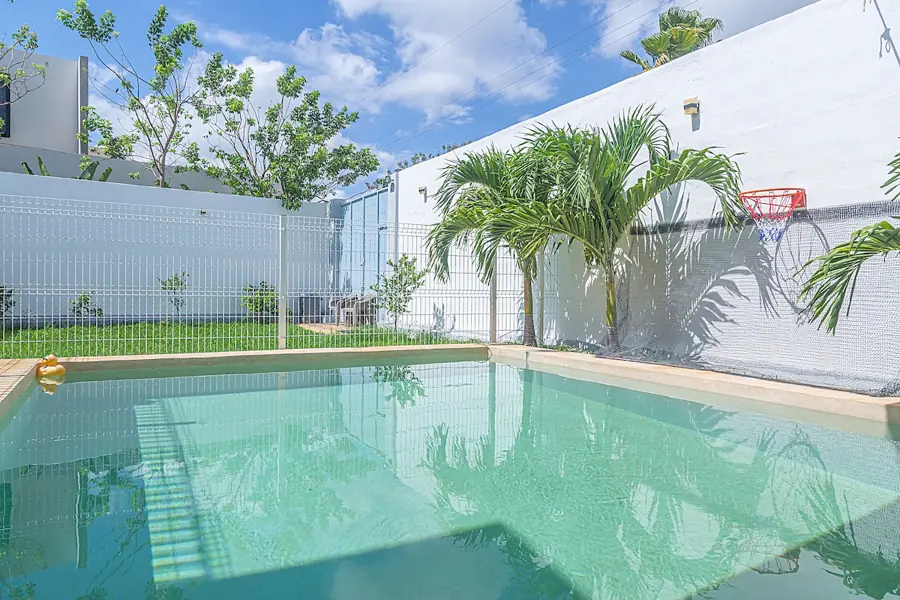
A foreign buyer of Casa Mila would hold it through a fideicomiso, because Dzityá is in the restricted zone. The house is a furnished four-bedroom, 5.5-bath pool home on a 474.80 m² corner lot, 335.59 m² built, with 20 solar panels, offered directly by its owner at USD 430,000 (MXN 7,950,000). Pamela and Raciel are the owner's representatives. WhatsApp +52 999 433 5982 for the location, which is sent only to people who are coming.
For the rest of the path — closing-cost numbers, the six checks before you offer, and how the money moves — use the 2026 buyer's guide. For what the neighborhood is like day to day, use the Dzityá living guide.
Balam is a jaguar, not a lawyer. This guide is general information for Yucatán as of November 2026, not legal or tax advice; your notary and accountant confirm the details of your case. Mexico's Best Homes offers no brokerage services and charges no commission until its Yucatán real estate license (INSEJUPY, Decree 73/2025) is issued. Casa Mila is offered directly by its owner. Pamela and Raciel are the owner's representatives.